


Australia and England’s cricket rivalry, most notably during Women’s Ashes matches, is rich in both history and emotion, making Australia Women’s National Cricket Team Vs England Women’s National Cricket Team one of the most compelling contests in women’s cricket.
The Ashes is a multi-format series consisting of Test matches (worth four points), one-day internationals and Twenty20 internationals. Prior to 2013, competition was determined solely based on Test match outcomes; but since 2013 all formats are competing for supremacy.
| Date | Format | Result | Margin | Location / Event |
|---|---|---|---|---|
| Oct 22, 2025 | ODI (World Cup) | Australia Women won | by 6 wickets | ICC Women’s World Cup 2025 |
| Jan 17, 2025 | ODI (Women’s Ashes) | Australia Women won | by 86 runs | Women’s Ashes 2025 |
| Jan 14, 2025 | ODI (Women’s Ashes) | Australia Women won | by 21 runs | Women’s Ashes 2025 |
| Jan 12, 2025 | ODI (Women’s Ashes) | Australia Women won | by 4 wickets | Women’s Ashes 2025 |
| Jul 18, 2023 | ODI | England Women won | by 69 runs (D/L) | Historic ODI series |
Australia
Australian Women’s National Cricket Team have long dominated world cricket since their establishment. Their undefeated run in both ODI and T20I matches is unparalleled, while many of its members rank amongst the most celebrated and highest-paid female sportspeople of their country.
A rich legacy has characterized Australia Cricket Board since 1894 when Tasmanian Ellen Mitchell initiated the inaugural local women’s competition.
Over a century later, Australia Cricket Board and England Women’s Cricket Association formalized competition, but it took until 1998 before an Ashes series trophy was created to commemorate this rivalry between two sides.
Over time, Australia established an irrefutable foundation of 50-over dominance. Under Belinda Clark’s tenure as captain from 2001 until 2005, player development and tactical discipline were prioritised; as a result of this approach Australia enjoyed lengthy ODI win streaks of 16-17 wins thanks to her strategic oversight.
Australia’s depth and fielding prowess are also significant assets in their arsenal. In 2005 against India, Australian women displayed extraordinary power and skill to rout them by 98 runs – marking their fifth ODI World Cup win and showing peak execution under high-pressure scenarios.
Even with its successes, Australia continues to face stiff competition from England – who have made major advances recently.
Their rivalry is especially intense during Twenty20 International matches where results tend to be close; nonetheless, Australians are considered favorites to continue dominating in this series this year.
No matter the outcome of this series, it will be an exhilarating contest between two of the world’s finest sides. Both squads boast talented players who possess the potential to lead their nation to glory; it will be fascinating to witness who emerges as the victor in 2025 and beyond! For now though, enjoy Thursday’s action in Sydney; it promises to be an enormous day in women’s cricket!
England
The England Women’s National Cricket Team represents England and Wales internationally in international cricket.
Over its history, they have won four ICC Women’s World Cup titles and established themselves as one of the premier sides in world cricket – winning two Ashes series titles as well as reigning one-day champs.
Most recently they triumphed by beating India at Lord’s in 2017’s ICC Women’s World Cup Final and lifting their fifth World Cup championship trophy!
The England and Wales Cricket Board (ECB) serves as the governing body of women’s cricket in England. Established in 1973 to promote women’s cricket and encourage more girls to take up the game, ECB also hosts regional hubs and academies across England in order to develop talent from within its membership base.
England came back from an initially slow start to defeat Sri Lanka and India to qualify for the quarter-finals, and eventually defeated Australia 0-2.
Despite losing this match-up 0-2 but with numerous impressive performances throughout, England ultimately prevailed overall to take home their first Women’s Ashes title since 1972 and celebrated this success alongside men’s team at Trafalgar Square.
England defeated Australia 12-4 and secured both the match and series victories in an impressive victory. Although early wickets left England reeling, a powerful partnership between Lydia Greenway and Sophie Sciver enabled their side to recover quickly from an uncertain position and dominate in fielding with captain Charlotte Edwards providing outstanding leadership on her day.
England’s opening match against Pakistan was relatively straightforward. Even with some top-order issues, batting all out for 294 runs gave them a solid chance at moving through to the semi-finals.
Holly Colvin took four wickets while Jess Cameron made an unbeaten century to set up their victory. Edwards and Taylor then contributed unbeaten hundreds to ensure a comfortable win.
Australia experienced some batting struggles early in their group campaign, but Annabel Sutherland and Ash Gardner ensured they had enough to overcome them. Sutherland scored an exceptional 98 while Gardner hit five boundaries during her 104-ball innings to ensure Australia qualified as group winners.
History
Men’s cricket may still feature the “Big Three”, while for women’s cricket there is one dominant nation: Australia has been dominating since Meg Lanning took charge in 1973 and won five out of seven World Cup titles as well as 8 of 12 ODI and T20 finals during her reign as captain.
Australia have led the charge in professionalizing women’s sport over the last decade with impressive feats that include winning a World Cup and five Ashes series wins consecutively, setting an astounding record in Test series competition and showing remarkable consistency over time.
That is due in no small part to the unprecedented levels of support that players are now receiving from all levels.
An unprecedented five-year MoU agreed between players’ union and governing body in 2017 marked as a watershed moment; total female player payments reached $55.2 million, including revenue sharing schemes that reinvested money back into grassroots cricket – Annabel Sutherland being one of many stars who saw her international salary skyrocket following this agreement.
Australia’s dominance extends to domestic competition as well, where competition quality has seen an unprecedented upsurge due to improved facilities, more training time and greater financial support for players.
This environment has created an enhanced professional playing experience in which top performers are given more of an opportunity to shine – something which has led to more young girls getting interested in the game through watching some of Australia’s renowned female cricketers appear in WBBL matches.
These factors have come together to form a positive feedback cycle, where higher competition level breeds better domestic players and larger audiences for international matches, creating an increasingly lucrative global market that in turn provides domestic leagues and teams with additional funding that allows them to attract the top talent.
Head-to-Head
Annabel Sutherland and Ash Gardner made headlines with their amazing 202-run partnership that provided Australia the boost they needed to defeat England and maintain top spot in Pool B. Their performance made a powerful statement and displayed yet again their unsurmountable strength at this level of cricket.
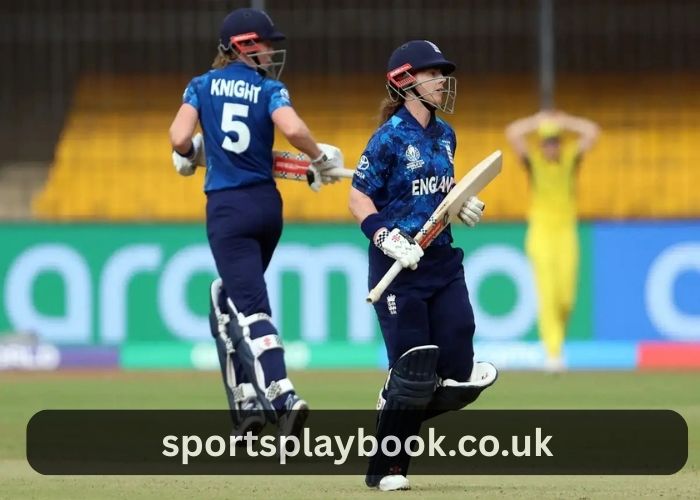
After Tammy Beaumont scored her 78, England’s middle order quickly disintegrated after, with Heather Knight falling for single figures (bowled by Sutherland beauty), Nat Sciver-Brunt for single digits, Sophia Dunkley in particular stuttering in reaching 22 from 48 deliveries and Alice Capsey and Charlie Dean sharing an unbroken seventh wicket stand of 61 but ultimately falling to 244-9 against India at Indore.
Australia’s reply saw another dip, plunging from 24-3 to 68-4 due to Bell’s brilliant offspin delivery to Litchfield for six.
Smith then dismissed Georgia Voll on the slog-sweep while taking down Ellyse Perry off her own bowling before Sutherland and Gardner led a remarkable comeback, winning by six wickets with an unbroken partnership of over 150 that showed Australia’s impressive depth.