
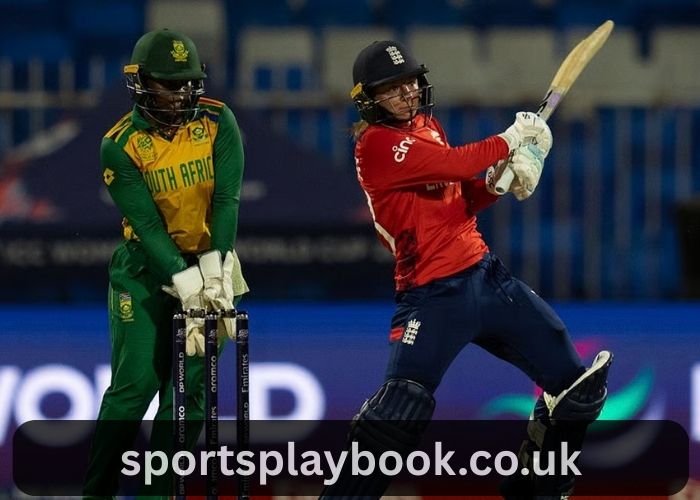
As Beaumont wafted at an innocuous delivery from Khaka, England’s hopes seemed close to an end in the England Women’s National Cricket Team Vs South Africa Women’s National Cricket Team clash.
But Kapp was determined and added Sophia Dunkley and Charlie Dean to her haul, helping South Africa turn the game on its head against the England Women’s side.
But Kapp was determined and added Sophia Dunkley and Charlie Dean to her haul, helping South Africa turn the game on its head against the England Women’s side.
These tri-nation engagements highlighted team versatility and laid the groundwork for future success. England then claimed victory at the 2009 ICC Women’s World Cup.
| Date | Match | Result | Winner |
|---|---|---|---|
| 03 Oct 2025 | ICC Women’s World Cup ODI | England Women beat South Africa Women by 10 wickets | England Women |
| 11 Dec 2024 | ODI (DLS Method) | England Women beat South Africa Women by 6 wickets | England Women |
| 08 Dec 2024 | ODI | England Women beat South Africa Women by 6 wickets | England Women |
| 04 Dec 2024 | ODI | South Africa Women beat England Women by 6 wickets | South Africa Women |
| 18 Jul 2022 | ODI | England Women beat South Africa Women by 109 runs | England Women |
England
The England Women’s National Cricket Team represents England in international women’s cricket at its highest level – the ICC Women’s Championship – and is based in Birmingham with support provided by England & Wales Cricket Board and International Cricket Council (ICC). Nicknamed The White Rose.
The Women’s team are currently ranked fifth by the International Cricket Council and have won seven out of thirteen matches this year so far. Looking to improve on last year’s runner-up finish at the T20 World Cup, England are confident they can win their remaining games and secure a top four finish despite an unexpectedly rocky start to this year’s campaign.
England made history at the inaugural ICC Women’s T20 World Cup, becoming the first team ever to win all three of their matches and claim victory with eight wickets and 18 balls to spare.
Their success was in large part credited to Katherine Sciver-Brunt who finished as top bowler with four wickets while also contributing an outstanding performance with both bat and ball.
England was among the pioneers of Test cricket during the 1960s and 70s, with players like Jan Brittin making his mark.
Additionally, England also won multiple bilateral One Day International (ODI) series against touring sides which helped further promote this format. Unfortunately for England in the 1980s, as they struggled to maintain their historical advantage against Australia as they lost five-match Test series and one ODI match during this decade.
But the White Rose have found renewed hope, and are once more on track for making history at the Women’s World Cup.
Their goal: reaching the coveted top four and exorcising the ghosts of Guwahati and Christchurch to gain another shot at winning back the trophy they lost so brutally at Bristol.
But their opponent this time around will be South Africa, who have also made an impressive start and look set to become the first team ever to reach all three formats of competition and reach its semi-finals simultaneously.
South Africa
The South Africa women’s national cricket team, commonly referred to as the Proteas, represents South Africa in international women’s cricket competition. Organised by Cricket South Africa (CSA), which is a full member of the International Cricket Council;
The Proteas compete in ICC Women’s Championship matches – considered to be the pinnacle of competition among women’s cricket – as well as one day internationals (ODIs) and Twenty20 tournaments; plus other related international tournaments for women’s cricket competition.
South Africa made its Test debut in 1960, becoming only the fourth country after Australia, England and New Zealand to do so.
Unfortunately due to an anti-apartheid boycott which banned any international fixtures between 1972 and 1997. Since 1997 however, South Africa have returned and have participated in all Women’s World Cup editions since.
The Proteas have found tremendous success in Twenty20 competition, winning three out of the six World Cup titles they’ve entered since 2003. 2023 tournament was particularly noteworthy when Springboks overpowered reigning champs England in an intense semi-final encounter in Paris to claim South Africa’s inaugural victory at this tournament – reflecting newfound confidence and cohesion within their side.
While the match against England offered many positives, some of its weaknesses became readily apparent as well. Batting has long been an issue, with Amy Jones and Heather Knight failing to live up to expectations while Tammy Beaumont failing to fulfill her potential.
Bethell and Katherine Sciver-Brunt are promising young players, but for the Proteas to contend in major tournaments they must address their batting issues first. In the interim, South Africa can look forward to facing Ireland in November for an excellent test of their abilities.
Longer term, their goal is to qualify for England and Wales 2019 Women’s World Cup where they hope to repeat past success against England in England and Wales. The Proteas have been drawn in Pool B of the 2018 FIFA World Cup alongside Ireland, India and New Zealand.
This will mark their second appearance at a tournament of this magnitude; their expectations should increase significantly from their 2017 performance. Jenny van Dyk is in charge since 2014 with support from Lisa Keightley leading their coaching staff.
ODIs
The South Africa women’s national cricket team, commonly referred to as the Proteas, represents South Africa in international women’s cricket competition. Managed by Cricket South Africa (CSA), which is a full member of the International Cricket Council. Competing at its highest level – the ICC Women’s Championship.
The Proteas have won six out of the eight ODI series against England so far and are looking to equal their record by winning seven straight matches against them in Johannesburg since 2012. Furthermore, they have won the last three ODIs at home against them with victories.
South Africa defeated England by 125 runs to reach their inaugural World Cup semi-final at Guwahati. Laura Wolvaardt scored an unbeaten century from just 143 balls – an unprecedented score in an ODI World Cup match! – with Marizanne Kapp capturing 5-20 to send Amy Jones and Heather Knight packing.
Tammy Beaumont was caught behind off Ayabonga Khaka, while Nat Sciver-Brunt died shortly after reaching 50 but Chloe Tryon and Sophia Dunkley offered late cameos that helped England achieve 194-9 total.
After winning the toss, England’s hopes of an unlikely comeback were dashed by Kapp’s brilliant bowling performance. She dismissed both Jones and Knight in double-wicket maiden before dismissing Tammy Beaumont from one over, leaving England reeling at 1-3.
Sciver-Brunt and Alice Capsey then put on an impressive 107-run partnership before Sciver-Brunt fell for an outstanding 67 before Kapp completed her impressive spell by taking out Capsey as Kapp took four more wickets; finally Dunkley Dean offered late cameos before England were finally dismissed in 43 over.
T20s
Two of the world’s greatest teams squared off in an electrifying contest on the stage of an sell-out crowd at The Oval on Sunday evening. India held their nerve to emerge victorious in ICC Women’s World Twenty20 final and complete an unprecedented double in an international 20-over tournament – previously winning its men’s version in 2007.
Shafali Verma led India with her powerful innings, scoring an unbeaten 87 off 78 balls while Deepti Sharma hit 58 to help their hosts post 298-7. South Africa kept themselves competitive through Laura Wolvaardt’s superb one-day innings; which kept their side within striking distance.
South Africa set a record fastest women’s T20I century as she attacked England bowlers with a magnificent 52-ball hundred in just 52 balls, smashing sixes over long-on off Sophie Ecclestone as well as hitting sixes to hit boundary-hitting sixes and hit over long-on.
Unfortunately, her removal in 42nd over – caught by Amanjot Kaur at deep midwicket off Sidra Amin – left South Africa needing to score 88 runs from 10 overs to remain competitive.
Captain Chloe Tryon and Nadine de Klerk came forward, and although both suffered relatively low scores (de Klerk was edged to short leg by Ayabonga Khaka and Tryon was caught at long on by Shannon Gabriel off Nondumiso Shangase), their partnership of 117-2 was unbreakable – virtually guaranteeing victory!
Kapp, having earlier removed Amy Jones and Heather Knight without scoring, took control of the match when she took five more wickets without scoring from Capsey on 28 (dropped by Khaka at long-off on 28), before Sciver-Brunt holed out to deep midwicket when trying to hit Luus for her winning boundary – however Tryon (36-3 from 33 balls) kept them under control with her aggressive knock.
Now that the result has been decided, South Africa and England’s rivalry has reached new heights; each match now tells an in-depth tale.
Since India honed their discipline while South Africa explored aggression and raw pace during their early 2000s encounters, both have learned valuable lessons for future clashes.