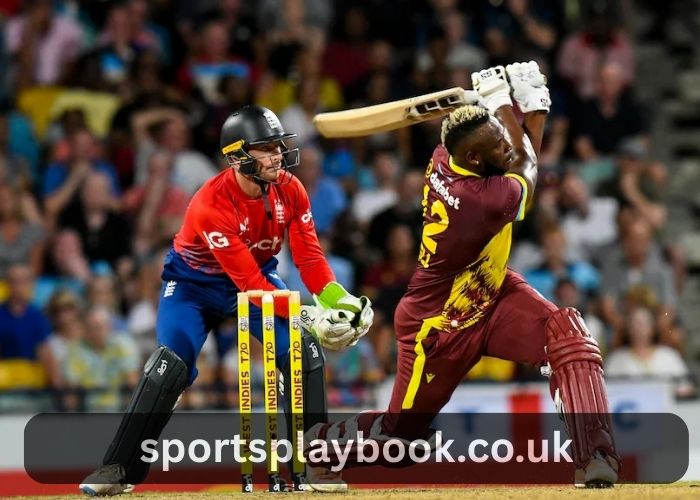
England fast bowler Reece Topley expects the Daren Sammy Cricket Ground to be a “cauldron” of an atmosphere when the two most successful Twenty20 sides meet in their Super Eight game on Wednesday.
This is one of the most enduring rivalries in global cricket. It reflects shifting eras, cultural identity, and colonial history. The West Indies Cricket Team Vs England Cricket Team matchups have produced legendary game enthusiasts, unforgettable fits, and dramatic series.
| Date | Format | Match | Result | Key Notes |
|---|---|---|---|---|
| 10 Jun 2025 | T20I | England vs West Indies, 3rd T20I (Southampton) | England won by 37 runs | England posted 248/3; West Indies 211/8; sweep in T20 series. (ESPN) |
| 08 Jun 2025 | T20I | England vs West Indies, 2nd T20I (Bristol) | England won by 4 wickets | England chased 188/6 with balls to spare. |
| 06 Jun 2025 | T20I | England vs West Indies, 1st T20I (Chester-le-Street) | England won by 21 runs | England 188/6; WI 167/9. |
| 03 Jun 2025 | ODI | West Indies vs England, 3rd ODI (The Oval) | England won by 7 wickets (DLS) | WI 251/9 (40 ov); ENG 246/3 (29.4 ov). |
| 01 Jun 2025 | ODI | West Indies vs England, 2nd ODI (Cardiff) | England won by 3 wickets | Joe Root scored 166* to chase 309. (ESPN.com) |
Origins
The west indies cricket team has a unique place in the world of sports. They are more than just a collection of athletes, they are a symbol of the Caribbean’s struggle for independence and the lingering legacy of slavery.
This makes the team’s successes and failures resonate more than those of other teams. A loss by the West Indians is not a mere defeat, it’s a sign of a national decline.
In the summer of 1976, the West Indies swept England in a series that many considered one of the greatest tests in history.
They would go on to dominate the world of test cricket for decades to come, winning two of the first three One Day International (ODI) World Cups and inflicting a record five-game series whitewash on Australia in 1985.
After a series of losses to the better-funded, more disciplined English side, the Windies were reborn under the leadership of Guyana-born Clive Lloyd.
His focus was to build a skilled and unified team. He drew inspiration from two players in particular: Learie Constantine and George Challenor. The former was a white man from Barbados’ upper class; the latter was a black Trinidadian from the lower middle classes who dazzled crowds with his athletic fielding and powerful stroke play.
But while Constantine and Challenor embodied the characterization of West Indian players as flamboyant entertainers who wilted under pressure, Lloyd was determined to retire that stereotype once and for all. In his book Grovel!,
historian David Tossell describes how the Windies responded to Greig’s remark. “They were outraged,” he writes. “Not only at the implicit racial insult and the slur on their profession, but also because it was an opportunity to demonstrate to the world that they were no grovelling apes.”
That passion and resentment was evident in the Windies’ performances on the field. Their bowlers terrified opposition batsmen, making them crouch in S-shapes to fend off the steepling bounce and face the specter of a devastating yorker aimed at their toe-caps.
Unlike the Australians, whose fast-bowling did not inspire such a fierce reaction from critics, the West Indians were perceived as an existential threat to a global order that still held racial prejudice.
Formats
The West Indies cricket team is the national cricket team of a group of English-speaking Caribbean countries.
The team is administered by the West Indies Cricket Board (WICB) and is known colloquially as “the Windies”. The West Indies have a long and rich history in the game of cricket, and are sometimes referred to as the Empire of Cricket.
West Indies is one of the founding members of ODI cricket, having played their first match in 1973. The Windies have won two World Cups (in 1975 and 1979, when it was styled the Prudential Cup), and also finished runners-up in three occasions (in 1983, 2006, and 2016). They have also won the ICC Champions Trophy once.
One of the most famous West Indian innings came in 1948 against England in Bridgetown. It was in this game that Gary Sobers made 365 not out, which at the time stood as a world record score. The innings, which lasted over six days and included 38 fours, eclipsed Len Hutton’s 364 against Australia in 1938.
The Windies became a dominant force in Test cricket during the second half of the 20th century, winning several series against major opponents.
They dominated the period from the mid-1970s to the late 1980s, and were a major rival for England, India, South Africa, and Australia. This period saw the emergence of fast bowlers like Frank Worrell, Everton Weekes, and Sonny Ramadhin, as well as batsmen such as Viv Richards and Garfield Sobers.
During this period, the West Indies also pushed to become pioneers of Twenty20 international cricket, and won their first ODI title in 1996.
The Windies have since won two more ODI titles, in 2012 and 2016, and also finished as runners-up in the 2014 edition.
In the era of T20 international, the Windies have developed a number of big hitters in Chris Gayle, Marlon Samuels, Kieron Pollard, Dwayne Bravo, and Andre Russell.
In addition, the Windies have a number of quality spinners in Jomel Warrican and Khary Pierre. The latter duo will have to work hard to contain the potent Indian attack, which includes the fast bowlers Mohammad Amir and Jasprit Bumrah.
History
In the 1970s and 1980s, the West Indies team was widely regarded as one of the strongest in cricket history. It won the first ICC World Cup in 1975, and also won it again in 1979. The team is composed of players from the Caribbean nations, and it has a number of famous legends, including Frank Worrell, Clyde Walcott, Everton Weekes, and Curtly Ambrose.
The West Indian Cricket Board joined the sport’s international ruling body, the Imperial Cricket Council, in 1926, and they were granted Test status in 1928. During their early days as a Test nation, the Windies were not very successful.
However, they soon began to dominate the game and were nicknamed the “Empire of Cricket”. Their great teams in the 1970s and 1980s included the peerless Garfield Sobers and the all-conquering dynasties led by Clive Lloyd and Viv Richards.
While the era of the Empire of Cricket has come to an end, the West Indies is still a dominant force in the modern game.
They have won two ICC World Twenty20 championships, and they are one of only three teams to win the tournament twice. In addition, the men’s team was the first to win both the World Cup and the Champions Trophy on the same day, with Carlos Braithwaite smashing four sixes in the final over against Sri Lanka.
While the West Indies are currently not as strong as they were in their heyday, the future of the island nation’s cricket is bright. The game is popular amongst the West Indian population, and it continues to be a big part of the culture.
In addition to being an important social outlet, cricket is also used for recreation and exercise, and it helps the local economy by providing employment and generating revenue for the government. There are also several private cricket clubs and academies in the region.
Matches
Darren Bravo’s side fought back with a spirited display in the final Test to seal a 1-0 series victory over England in Grenada. The game was a low-scoring affair with neither side able to break the deadlock over the course of five days.
But the Windies’ young batsmen stepped up to the plate and produced some impressive performances in the lower order. Sherfane Rutherford, who made his T20I debut at Edgbaston, was among the most impressive.
He looked a real threat to the England bowlers, scoring 69 off 55 balls. Keacy Carty and Alzarri Joseph also showed plenty of promise.
A win in the fourth ODI ensured that England would secure a series clean sweep against the West Indies, their best record in a series of three or more matches against a Full Member country. But it was not a straightforward match, and the first half-hour of play was disrupted by rain.
After a lengthy delay, play resumed at 2 pm. England won the toss and elected to field, but despite losing four early wickets, they managed to post a decent total of 246 for 6.
Chris Gayle once again played a key role, hitting a brilliant century off just 67 balls. He joins a very exclusive club of players who have scored over 10,000 one-day international runs.
Jos Buttler’s ominous form continues to cause problems for the Windies, and his next delivery clatters over square leg for another six. It takes him to within 26 of claiming his second ODI fifty and a clean sweep of the series.
In the previous ODI, England’s batsmen ripped through the Windies’ attack to reach their target with ease. The visitors finished the series with an impressive run-rate of 7.45, their highest in a series against a Full Member nation.
The next time the two teams meet, it will be in a T20I at Edgbaston. Both sides are looking to build on their positive starts and put in a strong performance. With both teams in good form, this match is sure to be a thriller.